
Cooking-Line Grease
Kitchen floor degreasing breaks up oily residue around fryers, ranges and preparation areas using chemistry selected for the floor and the type of soil.
Serving St. Petersburg, Florida & surrounding areas
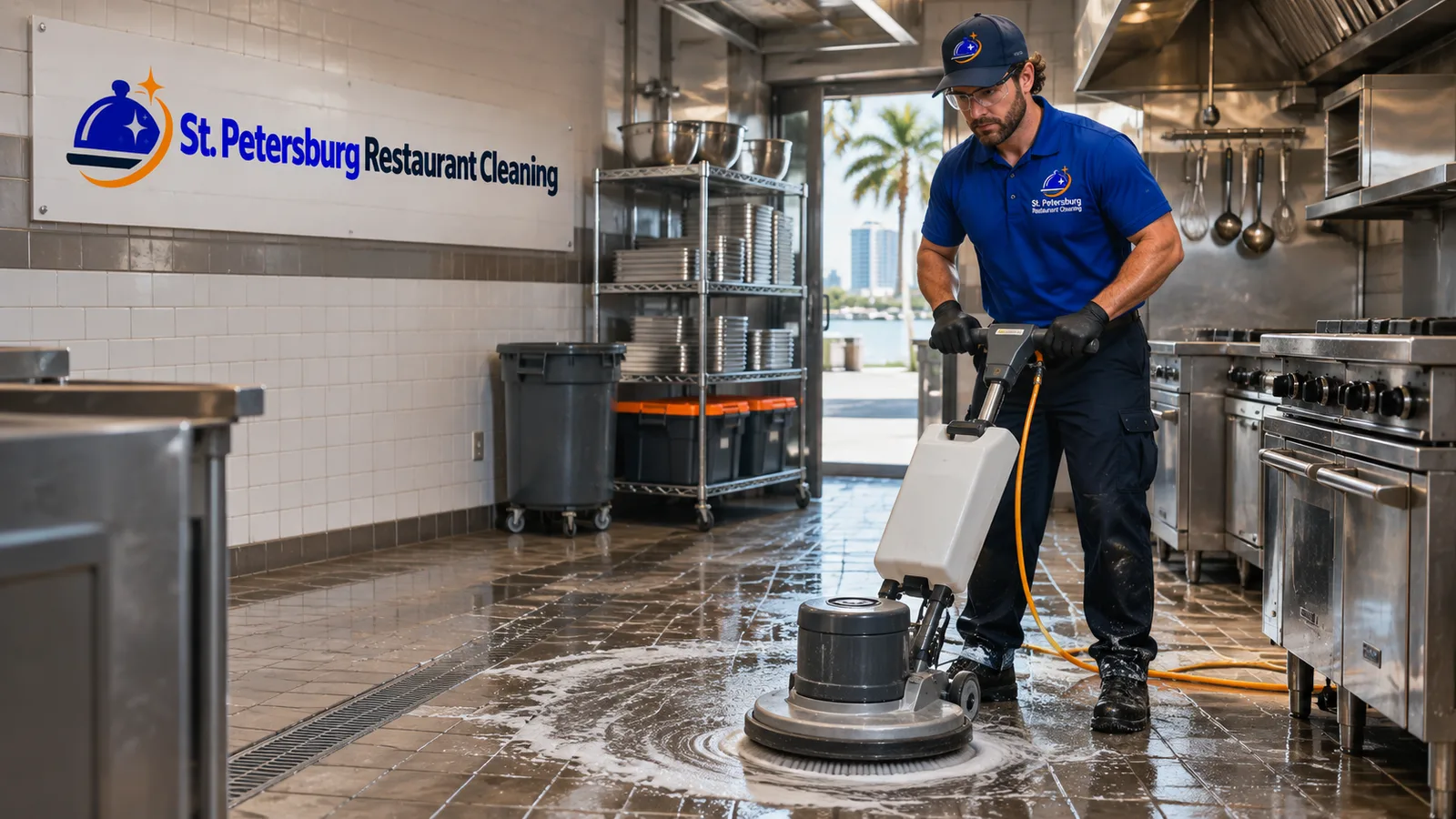
Kitchen Floor Cleaning · St. Petersburg
Remove stubborn grease, dark grout buildup and food-service soil with a cleaning plan built around your flooring, operating hours and safety needs.
A floor-specific scope accounts for grease zones, tile and grout condition, equipment access, soil recovery and enough drying time before kitchen traffic resumes.
Service Scope
Commercial Kitchen Floor Cleaning targets the grease film, food residue and compacted soil that routine mopping can leave behind. In a working restaurant, oily residue can migrate from fry stations and cooking lines into grout joints, corners, traffic lanes and areas beneath movable equipment. Reusing dirty mop water may spread that film rather than remove it.
St. Petersburg Restaurant Cleaning approaches this work as an experienced restaurant team in St. Petersburg, FL, matching the cleaning method to the floor material, soil load and operating schedule. The goal is a consistent clean across open tile surfaces, edges and grout without disrupting food preparation more than necessary.
Local kitchens face year-round restaurant activity, frequent deliveries and tracked-in sand during wet weather. Downtown dining rooms may have narrow service areas and limited loading access, while Central Avenue businesses often need work coordinated around evening traffic and closing routines. Restaurants near the waterfront can also experience steady foot traffic that carries outdoor soil toward kitchen transitions. These conditions affect equipment access, drying plans and how the work should be scheduled.
Tile and Grout Care
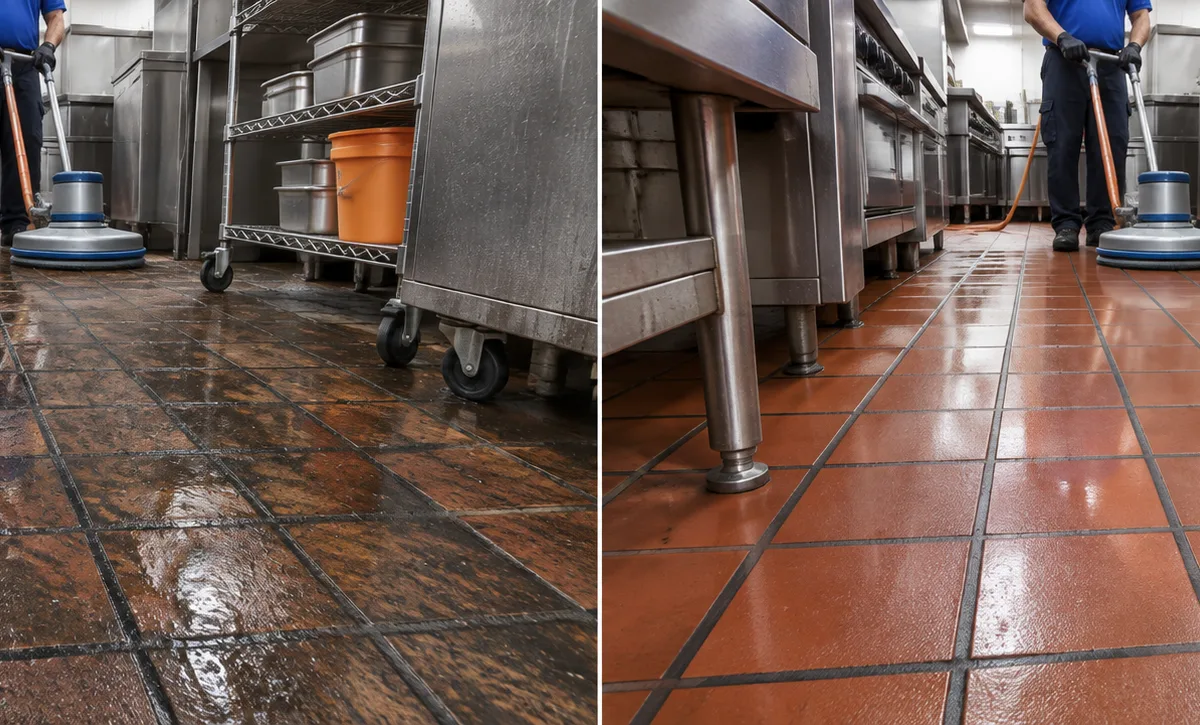
Tile and grout do not soil in the same way. Many commercial tiles are relatively easy to maintain when their surface is intact, but cementitious grout is porous and can retain greasy residue. Low areas, damaged joints and textured quarry tile may also hold soil after a quick mop.
Restaurant tile cleaning begins with dry soil removal and a compatible cleaning solution. The solution needs enough dwell time to loosen the bonded film before agitation. Mechanical scrubbing helps reach textured surfaces and grout lines, while controlled recovery removes suspended soil instead of redistributing it. Edges, corners, floor-to-wall transitions and accessible areas around equipment require separate attention because large machines cannot reach them effectively.
Restaurant grout cleaning can improve joints darkened by removable soil, but cleaning cannot repair cracked, missing or permanently stained grout. We identify those limits before work begins. Acidic chemicals are not the default answer for dirty grout because they may damage cement-based joints and are unsuitable for some floor materials.
Areas and Tasks
Kitchen floor degreasing breaks up oily residue around fryers, ranges and preparation areas using chemistry selected for the floor and the type of soil.
Focused agitation reaches recessed joints and textured surfaces where grease and fine debris tend to collect.
Detail work covers corners, thresholds, floor-to-wall transitions and accessible equipment perimeters that routine machine passes may miss.
Suspended residue is recovered with suitable extraction or wet-vacuum equipment so it is not left to settle back onto the floor.
One-time deep cleaning can reset a neglected floor, while recurring service helps control buildup based on cooking volume and floor condition.
The scope accounts for movable equipment, fixed installations, floor drains, narrow aisles and the time available before staff return.
Service Process
We identify the flooring type, coating condition, grout damage, heavy grease zones, drainage points and equipment that can be safely moved. The walkthrough also establishes access and timing.
Loose debris is removed, accessible items are cleared and nearby surfaces are considered before wet work begins. Food, utensils and exposed preparation items should be secured by restaurant staff.
A compatible cleaner is applied at the appropriate dilution. It is given controlled dwell time so grease can loosen without allowing the solution to dry on the surface.
Mechanical scrubbing handles the main floor, while detail tools address grout joints, corners, transitions and accessible areas around fixed equipment.
The loosened soil and spent cleaning solution are recovered. Rinsing is adjusted to the chemistry and floor so residue is not left behind.
We review treated areas, note damage that cleaning cannot correct and allow for drying before normal kitchen traffic resumes.
Controlled Degreasing
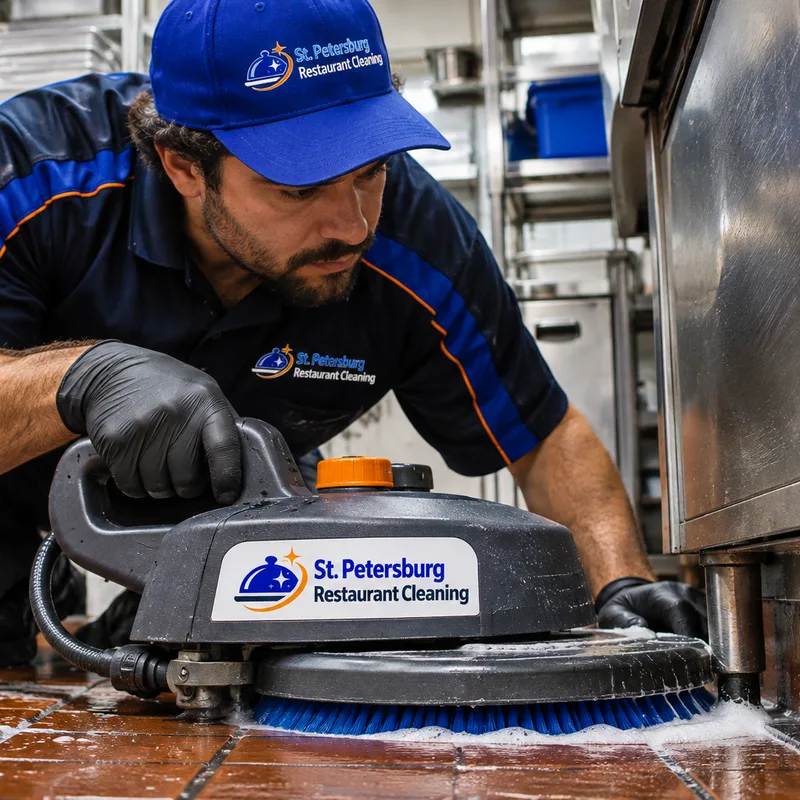
Effective restaurant floor degreasing depends on chemistry, contact time, agitation and recovery. Stronger is not automatically better. An overly concentrated product can leave residue, affect coatings or create handling concerns, while an under-diluted cleaner may fail to cut the soil. The floor manufacturer's guidance and the product label matter.
We also separate cleaning problems from repair problems. Loose tile, failed grout, damaged epoxy, poor drainage and standing water cannot be corrected by scrubbing. Heavy grease beneath fixed equipment may require access that only becomes available when the restaurant moves or disconnects that equipment through the appropriate trade.
In humid Gulf Coast conditions, drying time and ventilation deserve attention. A cleaned floor should remain out of service until it is dry enough for normal traffic. For late-closing restaurants in Downtown St. Petersburg or along Central Avenue, the work window must account for cleaning, recovery and drying before the next shift arrives.
Local Pricing
Commercial kitchen floor cleaning in St. Petersburg typically costs about $0.30 to $0.75 per square foot, while small or heavily soiled kitchens may carry minimum service pricing of roughly $250 to $600. Recurring maintenance may cost less per visit than a major restorative cleaning.
Final pricing depends on floor area, grease load, tile texture, grout condition, equipment access, required detail work and the available service window. The written scope should state what will be moved, which areas are included and whether drying time affects reopening. Exact cost is confirmed after an inspection or service consultation.
Request a CallbackLocal Planning
A useful proposal should define the cleanable floor area, the treatment method and any access limits. It should also explain who moves racks, mats and portable equipment. Fixed cooking equipment generally stays in place unless the restaurant arranges safe disconnection and movement by qualified personnel.
The right frequency depends on cooking methods, traffic and daily maintenance. A high-volume fryer line can develop grease faster than a lightly used preparation kitchen. Consistent sweeping, fresh mop solution and prompt spill cleanup help between professional visits, but they do not replace periodic agitation and recovery when residue has bonded to tile or settled into grout.
Scheduling should follow the operation rather than a generic timetable. Beach Drive dining activity often makes after-close coordination practical, while Grand Central District restaurants may need service planned around events and weekend traffic. In both settings, clear access and enough drying time matter more than the neighborhood name. St. Petersburg Restaurant Cleaning can assess the floor and prepare a scope for one-time or recurring commercial floor cleaning in St. Petersburg.
A short walkthrough can identify the heaviest grease zones, access limits and the right service interval before work is scheduled.
Call for a Free QuotePractical Answers
Many commercial kitchen floor cleaning visits take several hours, but the actual window depends on floor area, soil level, grout detail and equipment access. A compact Downtown St. Petersburg kitchen with narrow aisles may require more hand detailing than a larger open floor. Drying time must also be included before staff resume normal traffic.
Professional cleaning can remove substantial grease and removable soil, but it cannot guarantee the reversal of permanent staining or material damage. Cementitious grout may remain discolored after soil is removed, and cracked joints, worn coatings or damaged tile require repair rather than stronger chemicals.
Portable items and floor mats should be cleared when practical, while fixed or connected equipment usually remains in place. The inspection identifies what the cleaning team can safely move. Gas, electrical, plumbing or ventilation connections should only be handled by appropriately qualified personnel.
Yes, service can often be planned around closing hours and kitchen access, subject to availability. The work window needs enough time for preparation, degreasing, agitation, soil recovery and drying. This is particularly relevant for Central Avenue and Beach Drive restaurants with long evening operating hours.
The interval should be based on cooking volume, grease exposure, floor texture and the quality of daily maintenance. Frying operations may need more frequent deep cleaning than low-grease kitchens. A walkthrough can establish a practical starting schedule, which can then be adjusted according to actual buildup.
Degreasing can be suitable for quarry tile and many epoxy flooring systems when the chemical, dilution and agitation method are compatible with the surface. Existing coating failure, loose grout or unknown flooring should be identified first. Product labels and manufacturer care guidance take priority over a one-method-fits-all approach.
A clear quote should identify the treated area, cleaning method, equipment-moving limits, major exclusions and expected service window. It should also address heavy buildup, grout detailing and drying needs. At the St. Petersburg property, the final scope can be matched to actual access rather than estimated from floor area alone.
Plan the Work
Tell St. Petersburg Restaurant Cleaning about the flooring, grease buildup and operating schedule. We will help define a practical scope for tile, grout and floor degreasing at your commercial kitchen.